I landed in Havana late at night. As I stood in line for passport control, I noticed a man with a notebook in his hand approaching foreigners and asking them all sorts of questions. He came to me too. Judging by his interrogation style, he was undoubtedly a Cuban intelligence agent. I had to tell him several times that I was there for tourism, but he didn’t seem convinced. He insisted on checking a whole list of biased assumptions, to the point that I was the last one allowed to exit the airport. I thought that perhaps traveling alone looked a bit too unusual and inevitably drew attention. I was not mistaken. Lonely visitors would prove to be a rare sight in Cuba.
The travel agency had sent a taxi to take me to my guesthouse in Havana. It was late in the evening, and the first thing that struck me was how dark the streets were. Old images from my childhood under communism in Eastern Europe instantly flashed through my mind—they would later return on countless occasions.
The ride was smooth only at the beginning, because the main road from the airport was in good condition, but as we approached the city, it became bumpy. My destination was in the historic center, and to get there we had to take a few narrow, muddy streets, where the pavement was either broken or simply absent, forcing drivers to navigate through boulders and crater-like potholes. In exchange, the area was slightly better lit and seemed livelier, although not necessarily in a positive way. People didn’t look as if they were out on the streets to have fun or to party, but rather because they had nothing else to do.
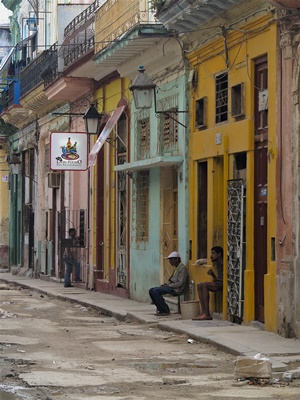
Streets in Havana
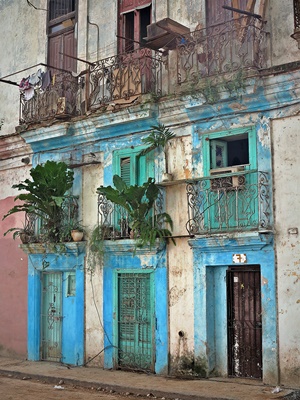
Finally, I arrived at my accommodation. It was an imposing house of neoclassical design, with high ceilings, shuttered windows, and wrought-iron balconies. The peeling plaster and faded paint on the facade were a common sight among most of Havana’s old buildings, and this one was no exception. Many years must have passed since it was last renovated—probably, before the socialist revolution. By all appearances, the house had belonged to a wealthy family and had been nationalized by the revolutionaries to be given to their collaborators, following the usual pattern of such regime changes. As a result, the interior had been modified for the cohabitation purposes of the new tenants. The rooms, originally very wide, had been divided by false walls to create additional space for temporary guests like me. The living room was shared, as was the kitchen. The furniture was an odd mix of massive wooden pieces, some with carvings or velvet upholstery, others plainly rustic, seemingly gathered from various sets dismantled decades ago.
Against this backdrop, the contribution of the current tenants to the decoration of the house was mercilessly striking, in painful contrast to the original style: the headrests of the sofas and armchairs were covered with plastic doilies, the walls were cluttered with reproductions of futuristic paintings, and the dining table boasted the largest collection of porcelain knickknacks ever encountered by the undersigned: dozens and dozens of figurines depicting puppies, kittens, ducks, deer, and unidentifiable species of colored fish. A veritable forest of kitsch objects planted right in the middle of that noble house, like a dagger stuck firmly in the heart of the class enemy.
It didn’t seem like the kind of place where people couldn’t afford something better. On the contrary, it was triumphantly overloaded with ugly and ill-matched items, in a garish display of compulsive possession.
“This is your room,” my hosts opened a door to show me. “If you need internet, you’ll have to ask. We have a computer and we can let you use it,” they added. My room was decorated in the same eclectic style as the rest of the house, but thankfully with fewer objects. It featured several carpet scraps with brown-green geometric patterns, as well as a pink satin cover on the hospital-like iron bed. The curtains, improvised from the same rosy fabric, were less than two-thirds of the windows’ height, even with the added nylon ruffles.
Nevertheless, the place was very clean, so I had no reason to complain, and fortunately the bathroom had been renovated. Despite the obvious mutilation, that house preserved such a strong personality between its robust walls, such a generous space under its tall ceilings, and so many secret whispers under its wooden floors, as though the traces of its former life, selfish and free, still floated in the air like a subtle mist, impossible to banish. That wild joie de vivre had impregnated the entire place, to the extent that not even the jungle of hideous knickknacks was able to alter it. It made me dream of lazy coffees on the balcony, calm afternoons with a glass of Cuban rum, and evening parties to the sound of old-style vinyl records. Time seemed to stand still in that house, trapped in the memory of a bygone era.
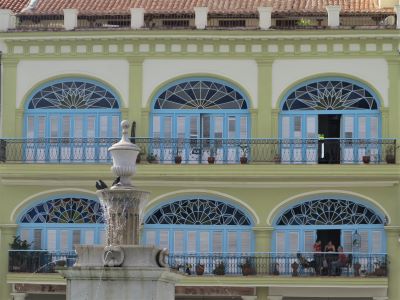
Buildings renovated recently
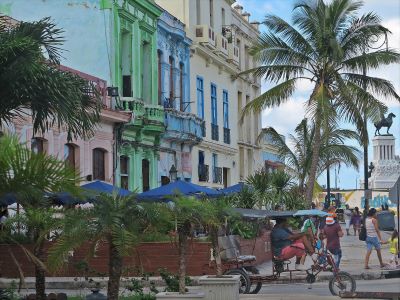
Almost every corner, every alley, and every square in Havana offered me a seductive yet desolate image. The old houses, such as the one I lived in, were like courtesans, once handsome and proud, now impoverished and decayed, left with nothing but regrets for their lost youth. Behind patched ornaments, dusty colonnades and overflowing clotheslines, their colorful frontispieces were begging time and weather for mercy. Occasionally, a passing ray of sunlight was enough to restore the illusion of their old charm, as if to prove that there was still some goodness and friendliness in them to please the eye. It was like a caress on the wrinkled cheek of a matriarch who had seen and endured a lot in her life and raised many children under her roof.
Captive to its heritage, the whole city seemed to be drowning in nostalgia. Behind its walls, the Havana Cathedral still preserved the end-of-the-world feeling that must have plagued the first missionaries when they thought they might never see the shores of Europe again. On the Paseo del Prado, one of the most vibrant arteries, the amateur artists waited in vain for a foreign Maecenas to discover them and change their destiny. And under the setting sun that spat fire on the smoky clouds, the legendary Malecón, the long seafront promenade where the locals used to go out in the evenings, appeared sad and deserted, with too many houses in ruins and no terraces or bars. Only the scattered whispers of a guitar, coming from some unknown troubadour and his group of friends on the pier, disturbed the sound of the sea waves like a swan song before nightfall. Even the salsa clubs, a veritable institution in Cuba and a popular place for parties, dancing, and fun, were taken over by the generalized spleen.
It was as though Havana was unable to experience joy other than in the shadow of her past.
Beyond the veil of melancholy, I could perceive something deeper and much more bitter: a sense of resignation and helplessness familiar to me from the early years of my existence. It was the unavoidable consequence of being born in a small and impoverished country, from where it was almost impossible to get out—because of an oppressive regime, an inconvertible currency, and multiple visa restrictions. With no freedom and no opportunities, any better version of the future was a lost cause.
People looked back all the time simply because there was nothing to look forward to.